Parents tell us all the time: “We’ve been to every specialist. We’ve run every test. But nobody can tell us why our child is struggling.”
If this sounds familiar, you’re not alone. You’ve watched your child deal with chronic ear infections, speech delays, sensory meltdowns, focus challenges, or sleep struggles that never seem to improve. You’ve done the blood work. Maybe even the MRI. Perhaps an EEG. And everything comes back… normal.
Yet your child is still struggling.
Here’s what’s actually happening — and why you haven’t gotten answers yet.
The Critical Gap in Traditional Pediatric Care
Traditional pediatric medicine is designed to look for pathology — disease, damage, or danger. Your doctor is asking one question:
“Is something seriously wrong?”
They’re looking for:
- Structural damage
- Disease markers
- Neurological abnormalities
But they’re not asking the most important question:
“How well is the nervous system functioning?”
Your pediatrician tracks height and weight at every visit with charts and percentiles. But the system that controls digestion, immunity, sleep, movement, behavior, emotions, and development?
That system rarely gets measured at all.
Why “Normal” Test Results Don’t Tell the Whole Story
Nearly 1 in 12 children in the U.S. has a speech or language condition — and most of them have completely normal MRIs, EEGs, and blood work.
Traditional tests ask:
“Is there something damaged?”
But for developmental delays, sensory issues, behavioral struggles, and chronic health challenges, the real question is:
“Is the nervous system coordinating and organizing properly?”
It’s like checking whether a car is totaled — instead of checking whether it actually runs well.
Meet Braxton: When the Right Test Changes Everything
Braxton was one week old when his parents were told he needed evaluation for seizures and infantile spasms. Every time they laid him on his back, he spasmed. They couldn’t sleep. They were terrified.
Specialists warned the spasms would likely worsen. The next step was a hospital EEG — but they had to wait four long weeks.
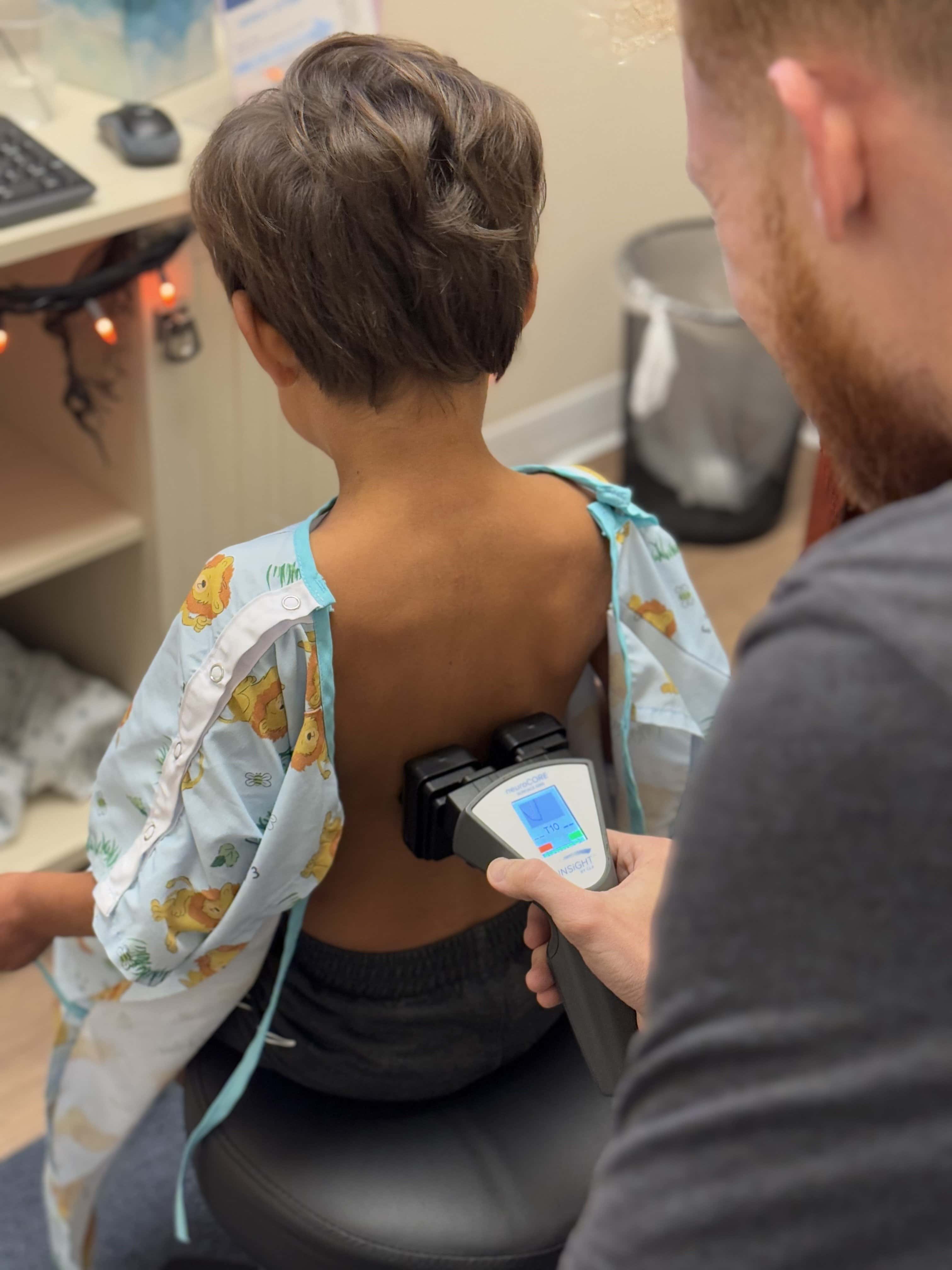
During that wait, their doctor recommended neurological INSIGHT scans.
The scans showed Braxton’s nervous system was extremely stressed and dysregulated. Birth trauma had locked his body into fight‑or‑flight. He physically couldn’t calm down.
After just one week of gentle, specific chiropractic adjustments:
- The spasms stopped completely
- He became calm and comfortable
- He slept peacefully
When the hospital EEG finally happened?
Completely clear.
Braxton is thriving today because his parents got the test that actually mattered — the one that measured function, not just disease.
Understanding INSIGHT Scans: Three Windows Into the Nervous System
INSIGHT technology provides three scans that work together to show exactly how your child’s nervous system is functioning — like three camera angles revealing the full picture.
The Neuro Thermal Scan
Shows how stress affects:
- Digestion
- Immunity
- Organ function
It explains chronic issues like reflux, constipation, frequent ear infections, and constant illness. When the nervous system is stuck in stress mode, it diverts resources away from digestion and immunity — and this scan shows where that’s happening.
The NeuroSpinal EMG Scan
Measures muscle tension along the spine and nervous system.
It helps explain:
- Developmental delays
- Sensory processing issues
- Focus challenges
- Coordination problems
This scan often reveals the patterns that finally make sense of your child’s struggles.
The Heart Rate Variability (HRV) Scan
Shows how well your child adapts to stress.
When kids struggle with:
- Transitions
- Emotional regulation
- Sleep
HRV often reveals why — their nervous system is stuck in overdrive and can’t shift gears.
Together, these scans create the complete picture traditional medicine never looks for.
The Patterns That Explain Everything: Raging Bull & Drunken Bull
INSIGHT scans often reveal two major stress patterns:
The Raging Bull Pattern
The nervous system is stuck in overdrive.
Common signs:
- Anxiety
- Hyperactivity
- Behavior issues
- Poor sleep
The Drunken Bull Pattern
The nervous system is uncoordinated and disorganized.
Common signs:
- Focus issues
- Low muscle tone
- Sensory challenges
- Learning difficulties
Many kids show both patterns — which explains why symptoms seem so varied and confusing.
The Perfect Storm: Why This Happens
These patterns usually develop from a combination of early stressors:
- Pregnancy stress
- Birth trauma (even “normal” births)
- Early illnesses
- Multiple rounds of antibiotics
- Environmental pressures
These stressors stack up, locking the nervous system into dysfunction.
Research shows that children who receive more than six antibiotic rounds before age three have significantly higher risks for allergies, asthma, and gut issues. Each round adds stress to an already overwhelmed system.
Why Your Child’s Therapies Might Not Be Working
You’re doing everything right — speech therapy, OT, behavioral therapy. Your child is working hard. The therapists are excellent.
But progress is painfully slow.
It feels like pushing a car uphill with the parking brake on.
When the nervous system is stuck in dysautonomia, therapies can’t integrate properly. The foundation isn’t ready.
Once nervous system balance is restored, therapies finally “stick.” Parents often see improvements in:
- Sleep
- Digestion
- Behavior
- Focus
- Immunity
And follow‑up scans prove the progress.
From Guessing to Knowing: The Power of Objective Data
INSIGHT scans replace guessing with clarity.
No more:
- “Let’s try this and see.”
- “Just give it time.”
- Collecting diagnoses without answers.
You get objective data showing exactly what’s happening — and exactly how your child is healing.
Your Child Isn’t Broken — They’re Stuck
Your child isn’t damaged. Their nervous system is overwhelmed.
Once we identify the patterns and address the root dysfunction, children have an incredible capacity to heal and thrive.
The patterns can change. The nervous system can reorganize. And when it does, everything else begins to fall into place.
You Deserve More Than “Wait and See”
If you’re tired of hearing “they’ll grow out of it” or collecting labels without solutions, you deserve better.
INSIGHT scans may be the missing piece you’ve been searching for.
Reach out to Hope Chiropractic to schedule a consultation and scans. If you’re not local, the PX Docs directory can help you find an office near you.
Your child deserves more than symptom management.
They deserve to flourish.
If you’d like, I can help you format all of these posts into a cohesive “Nervous System 101 for Parents” series with SEO‑friendly excerpts and Divi‑ready layouts.